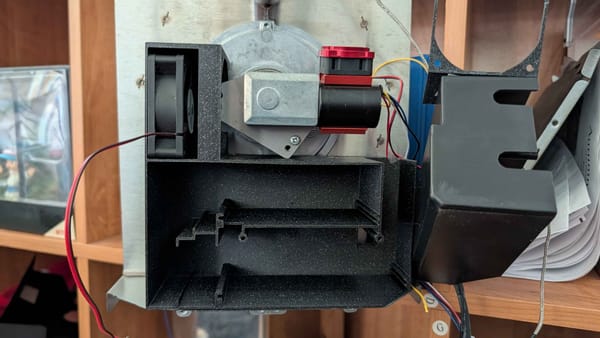
Skywalker Roaster Key Characteristics and Behavior

There are two main peculiarities of this machine that must be clearly understood:
1. High Thermal Inertia — But Not From the Drum
This roaster has very high thermal inertia, comparable to a commercial drum machine but for a different reason.
In a traditional drum roaster, inertia comes from the thermal mass of the drum and structure.
In this machine, inertia comes primarily from the infrared heating element (lamp).
The lamp does not respond instantly to power changes. Even after reducing power, it continues emitting significant radiant energy. As a result:
- Power changes have delayed effects.
- The rate of rise (RoR) reacts slowly.
- Large adjustments cause overshoot or collapse.
2. It Is NOT a Hot-Air (Convection-Dominant) Machine
Most small roasters operate thermodynamically like a body immersed in a hot convective environment.
This machine does not behave that way.
Heat transfer here is primarily radiative, not convective.
That means:
- The air is not the main heat carrier.
- The drum mass is not the main heat reservoir.
- The infrared radiation directly heats the beans.
This requires a completely different mindset compared to convection roasters.
Data and PID Control
Collecting roast data is absolutely useful but not for tight real-time PID control.
Trying to aggressively PID this machine is largely counterproductive because:
- The heater response is slow.
- Thermal inertia is high.
- The system overshoots easily.
Instead, use roast data to:
- Understand machine response characteristics.
- Plan future profiles carefully.
- Adjust timing, not constant power modulation.
This roaster prefers few deliberate power changes:
- 3–5 adjustments per roast are usually sufficient.
- The key variable is when to change power, not constant micro-adjustments.
- Heat step magnitude should be modest (5–10%), similar to gas drum roasters.
In contrast, on a convection roaster, you can sometimes maintain nearly constant power and achieve stable results.
Corrected Physics Explanation
Radiation Dominates
The infrared lamp emits radiation. That radiation:
- Is absorbed efficiently by dark organic material (coffee beans)
- Is poorly absorbed by air (air is largely transparent to IR)
- Is partially reflected by shiny metals
- Is absorbed moderately by darker drum surfaces
This aligns with radiation physics and blackbody absorption principles. Dark, matte objects absorb radiation well.
On First Crack Temperature (~182°C-190°C)
The relatively low FC reading is likely due to:
- Probe placement near bean mass
- Radiant-dominant heat transfer
- Less superheated air compared to convection machines
It is not necessarily probe miscalibration.
This roaster’s temperature readings represent a different thermal environment than hot-air roasters.
Design Implications
If the drum were polished stainless steel:
- Radiation reflection would increase.
- Bean heating efficiency would decrease.
- The system would struggle more to heat.
A darker drum improves radiative absorption.
Practical Takeaways
- Use fewer, deliberate power changes
- Think in timing adjustments rather than constant PID modulation
- Expect delayed RoR response
- Understand that radiation is dominant
- Do not compare temperature numbers directly with hot-air machines